
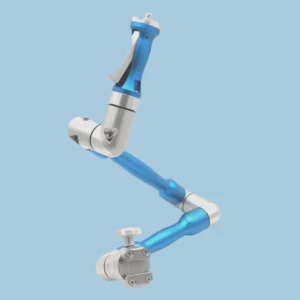
In orthopedic and arthroscopic procedures, the spider surgical arm has become a familiar term for articulated limb support systems that function as an intraoperative “third hand.” These systems are designed to hold, suspend, reposition, and stabilize the operative limb so surgeons can improve visualization, maintain access, and reduce dependence on manual limb holding during demanding shoulder, elbow, wrist, knee, and extremity procedures. However, not every surgical arm positioning system is engineered the same way. When comparing a Spider Arm style positioner with SchureMed’s SchureLoc XPS, the differences are especially important for facilities evaluating strength, workflow efficiency, OR table compatibility, sterility, accessory options, and long-term equipment value.
Why Surgical Arm Positioning Systems Matter
Arm positioning is not a secondary detail in shoulder arthroscopy, rotator cuff repair, total shoulder replacement, elbow surgery, hand surgery, and other upper extremity procedures. It directly affects exposure, portal access, traction control, surgeon ergonomics, assistant workload, and patient safety. A poorly supported limb can lead to unnecessary repositioning, workflow interruptions, increased staff fatigue, and inconsistent surgical access.
Traditional approaches often require one or more staff members to manually hold or adjust the arm throughout the procedure. While this may be workable in short or routine cases, it becomes inefficient in advanced arthroscopic procedures where small changes in abduction, flexion, rotation, or traction can influence the surgical field. Modern limb positioners help address these challenges by offering mechanical stability, multi-axis adjustment, and repeatable control.
A high-quality positioning system should support several clinical priorities:
- Secure fixation throughout the procedure
- Smooth intraoperative adjustment
- Compatibility with common OR tables and side rails
- Minimal clutter around the surgical table
- Sterile-field accessibility
- Reduced surgeon and staff fatigue
- Durable construction for repeated clinical use
- Accessory compatibility for different extremity procedures
Both Spider Arm style systems and SchureLock XPS aim to support these goals, but they approach them with different engineering priorities.
What Is a Spider Arm Positioning System?
A Spider Arm is generally understood as a multi-jointed surgical limb positioner used to support the patient’s arm or extremity during orthopedic and arthroscopic procedures. The term often refers to an articulated mechanical or powered support arm that mounts to the operating table and allows the surgical team to position the limb in multiple planes. Depending on the model, a Spider Arm may be used for shoulder arthroscopy, elbow procedures, wrist and hand procedures, knee positioning, or small joint surgery.
Spider-style systems are valued because they provide controlled limb positioning without requiring constant manual support. In many operating rooms, they are associated with shoulder surgery because they can help maintain the arm in positions that improve access to the glenohumeral joint and subacromial space. They may also assist with traction, rotation, and fine adjustments during arthroscopic visualization.
However, Spider Arm systems can vary widely by manufacturer and configuration. Some are battery-operated. Some rely on foot pedals. Some include powered locking mechanisms. Others use more mechanical articulation. This variation means purchasing teams should not assume that all Spider-style systems offer the same workflow, maintenance profile, table compatibility, sterile adjustment capability, or accessory flexibility.
What Is SchureLoc XPS?
SchureLoc XPS is SchureMed’s portable arm and hand positioner designed for surgical extremity positioning. It is built to provide rigid fixation and broad intraoperative range of motion while reducing clutter around the OR table. SchureMed positions the system as a high-performance option for shoulder arthroscopy, rotator cuff repair, total shoulder replacement, and other limb positioning applications.
One of the system’s most important design features is its six-joint motion controlled by a single lever. The single lever releases all six joints for varied positioning and relocks instantly when released. That design matters because OR teams need fast, controlled adjustments without unnecessary steps or complicated equipment interaction. In the sterile environment, a system that can be adjusted efficiently can help preserve workflow and reduce interruptions.
SchureLoc XPS also attaches to OR table side rails and is designed for broad rail compatibility. SchureMed’s product information specifies that the system attaches to side rails within defined rail width and height dimensions, allowing facilities to integrate the positioner into existing surgical table environments. SchureMed also offers the Complete SchureLoc XPS Shoulder System, which includes the SchureLoc XPS, a shoulder positioning chair, multi-axis arm positioners, Schure Socket XL, disposable sterile kit components, and other supporting products.
Key Difference 1: Mechanical Simplicity and OR Clutter
One of the biggest differences between SchureLoc XPS and many Spider Arm style systems is workflow simplicity. Some Spider-style positioners may require batteries, power connections, chargers, foot pedals, or additional components, depending on the specific system. These elements can be effective, but they also add considerations for setup, storage, charging, preventive maintenance, and room turnover.
SchureLoc XPS is designed with no foot pedals, hoses, hydraulics, or power cords around the operating room table. This is a significant workflow advantage in busy surgical environments where cable management, equipment footprint, and rapid setup all matter. Fewer external components can also support a cleaner OR layout and reduce tripping hazards or equipment congestion around the sterile field.
For orthopedic teams, the practical benefit is straightforward: the arm can be positioned and locked without managing a powered control system or navigating floor-based equipment. That makes SchureLoc XPS especially compelling for facilities looking for a strong, portable, mechanically efficient positioner that supports advanced extremity procedures without unnecessary complexity.
Key Difference 2: Six-Joint Single-Lever Control
Both Spider Arm style systems and SchureLoc XPS are designed for multi-directional limb positioning, but the control mechanism is a critical differentiator. SchureLoc XPS uses a single lever to release all six joints and relock the system instantly when released. This design gives the surgical team one-handed control over a broad range of limb movement.
In practice, that can support faster transitions between positions during shoulder arthroscopy or open shoulder procedures. When the surgeon needs improved exposure, the limb can be adjusted smoothly and then locked into place. Because all six joints respond through one control point, the workflow is intuitive and efficient.
A Spider Arm system may also provide multi-axis positioning, but the adjustment experience depends heavily on the model. Some systems may require a foot pedal or a separate activation step. Others may have different locking sequences or powered components. The question for purchasing teams is not simply whether the device articulates, but how quickly and reliably the team can reposition the limb under sterile operating conditions.
Key Difference 3: Sterile-Field Adjustment
Sterile-field control is essential during surgical arm positioning. If a system requires nonsterile handling for certain adjustments, the OR team may need additional staff coordination or procedural pauses. SchureLoc XPS is designed so that the patient’s limb can be adjusted intraoperatively while maintaining the sterile field. The system also works with sterile kits that include components such as sterile drapes, foam hand and forearm wraps, and self-adherent wrap.
This matters because positioning changes often happen during the case, not only before incision. During shoulder arthroscopy, surgeons may need to change arm angle, rotation, or traction to access different structures. A sterile-compatible system can reduce dependence on nonsterile support and help keep the procedure moving.
Spider Arm systems can also be used in sterile workflows, but the available draping, sterile attachment, and adjustment process depend on the system configuration. Facilities should evaluate how each option performs during actual intraoperative repositioning rather than focusing only on preoperative setup.
Key Difference 4: Table Compatibility and Rail Integration
Operating room table compatibility is one of the most practical considerations in surgical equipment purchasing. A limb positioner that performs well but requires narrow compatibility conditions can create scheduling limitations or force facilities to purchase additional adapters. SchureLoc XPS is designed to attach to OR table side rails within specified rail dimensions, and SchureMed’s broader product ecosystem includes robust clamp options for standard and universal rail configurations.
SchureMed’s clamp portfolio reinforces this compatibility-centered approach. Products such as the Schure Socket XL, Schure Socket, INFINITY Clamp, INFINITY Blade Clamp, and other rail clamps are engineered to secure surgical accessories to OR tables with reliable holding force. This matters because the positioning arm is only as dependable as the connection point anchoring it to the table.
A Spider Arm system may come with its own table clamp or mounting configuration, but compatibility can vary. Before purchasing, facilities should verify:
- Whether the system fits existing OR table rails
- Whether it can mount anywhere along the rail or only at specific notches
- Whether it works over drapes or rail stand-offs
- Whether additional adapters are required
- Whether the clamp supports vertical and horizontal accessory mounting
- Whether the stated load capacity matches intended clinical use
SchureMed’s strength is that it does not treat the arm positioner as an isolated product. It supports the broader OR positioning ecosystem with clamps, sockets, armboards, sterile kits, and complete shoulder system options.
Key Difference 5: Accessory Ecosystem
SchureLoc XPS is designed as part of a modular positioning platform. Available SchureLoc XPS accessories include the XPS Adapter, forearm attachment, armboard, counter traction post, elbow and ankle positioner, TKR positioner, femoral hook, retractor holder, and finger trap disposables. This accessory range gives facilities the flexibility to expand beyond a single shoulder positioning workflow.
The Complete SchureLoc XPS Shoulder System also combines the SchureLoc XPS with shoulder positioning chairs, multi-axis arm positioners, disposable head and chin straps, Schure Socket XL, sterile kits, and shoulder chair accessories. For surgical centers and hospitals, this system-level approach can simplify purchasing because the components are designed to work together.
A Spider Arm style system may have its own accessories, but the range and compatibility will depend on the manufacturer. Some systems are optimized for shoulder and small joint arthroscopy, while others may be more limited. The important question is whether the positioner can evolve with the facility’s procedure mix. If a system can support shoulder, elbow, wrist, knee, ankle, and accessory-based positioning needs, it may deliver more value across service lines.
Key Difference 6: Strength, Stability, and Fixation
Surgical arm positioning systems must provide both flexibility and rigidity. Flexibility is needed for positioning. Rigidity is needed once the desired position is achieved. A system that is easy to move but unstable under load can compromise exposure and increase intraoperative frustration. A system that is rigid but difficult to adjust can slow the team down.
SchureLoc XPS is engineered to combine strength and flexibility. Its design provides rigid fixation while supporting broad intraoperative positioning. The system is described as a lightweight mechanical robot arm that gives surgeons a “third arm” in the OR. This balance is particularly important in shoulder procedures where the limb may need to be held in demanding angles while the surgeon works through small arthroscopic portals.
Spider Arm style systems are also built around the “third hand” concept, but their rigidity, weight capacity, and lock strength vary by model. Facilities should assess real-world performance under the specific loads and positions used in their procedures. Demonstration trials can be especially useful because they reveal whether the arm drifts, whether the adjustment feels controlled, and whether the locking mechanism inspires confidence.
Key Difference 7: Maintenance and Operational Readiness
Any powered or battery-supported surgical device introduces operational considerations. Batteries must be charged, tracked, replaced, and available. Foot pedals and electronic components may require inspection and service. Power cords or chargers must be stored and managed. None of these issues necessarily disqualifies a Spider Arm system, but they do affect total workflow and long-term ownership.
SchureLoc XPS is appealing because it avoids many of these dependencies. With no power cords, hydraulics, hoses, or foot pedals, it is ready for immediate use once attached to the table. This can be valuable for high-throughput surgery centers where fast room turnover, predictable setup, and minimal troubleshooting are priorities.
From a procurement perspective, operational readiness should be evaluated alongside purchase price. A positioner that reduces setup steps, minimizes equipment clutter, and requires fewer external components may deliver meaningful savings in staff time and procedural efficiency.
Key Difference 8: Integrated Engineering and Customization Support
SchureMed’s broader value proposition is its in-house research, design, engineering, and manufacturing capability. This is especially relevant for facilities that need more than a standard arm positioner. If a surgical team has an unusual workflow, a complex orthopedic case mix, a unique table configuration, or a need for custom accessories, SchureMed can assess requirements and either recommend an existing product or design a solution from the ground up.
This engineering partnership model is a meaningful advantage over a simple product-only purchase. SchureMed can consider access angles, imaging constraints, patient sizes, procedural workflows, sterilization requirements, material selection, load limits, manufacturability, and long-term maintainability. For hospitals and surgical centers that want standardized, scalable OR positioning systems, that level of support can improve both implementation and long-term value.
Which System Is Right for Your OR?
The right choice depends on your clinical priorities. A Spider Arm style system may be familiar to surgeons who have used powered or articulated limb positioners in shoulder and arthroscopic procedures. It may be a viable option for facilities that already have compatible equipment, established workflows, and staff trained around that specific platform.
SchureLoc XPS is especially strong for teams that want mechanical simplicity, six-joint single-lever control, broad intraoperative adjustability, sterile-field workflow support, accessory flexibility, and a reduced equipment footprint around the OR table. It is also a compelling option for organizations that value domestic engineering support, integrated manufacturing, and the ability to build a complete shoulder positioning system from compatible components.
When evaluating either system, purchasing teams should consider:
- Procedure types supported
- Surgeon preference and ergonomics
- Range of motion and locking performance
- Sterile adjustment workflow
- Table rail compatibility
- Clamp strength and accessory stability
- Setup and turnover time
- Maintenance requirements
- Available accessories
- Long-term product support
- Total cost of ownership
FAQ
What is the main difference between a Spider Arm and SchureLoc XPS?
A Spider Arm is a general term for an articulated surgical limb positioner, while SchureLoc XPS is SchureMed’s specific portable arm and hand positioning system. SchureLoc XPS emphasizes six-joint single-lever control, rigid fixation, mechanical simplicity, and no foot pedals, hoses, hydraulics, or power cords around the OR table.
Is SchureLoc XPS used for shoulder surgery?
Yes. SchureLoc XPS is designed for procedures such as shoulder arthroscopy, rotator cuff repair, and total shoulder replacement, and it can be integrated into SchureMed’s Complete SchureLoc XPS Shoulder System.
Can SchureLoc XPS be adjusted during surgery?
Yes. SchureLoc XPS is designed for intraoperative adjustment while maintaining the sterile field, helping the surgical team reposition the limb efficiently during the procedure.
Does SchureLoc XPS require power?
No. SchureLoc XPS does not require foot pedals, hoses, hydraulics, or power cords around the operating room table, which helps reduce clutter and simplify setup.
Why does rail compatibility matter?
Rail compatibility determines whether the positioner can mount securely to the OR tables already in use. Secure rail fixation is essential for stability, patient safety, and consistent surgical exposure.
Can SchureLoc XPS support procedures beyond the shoulder?
Yes. With the appropriate accessories, SchureLoc XPS can support multiple extremity positioning applications, including elbow, wrist, knee, ankle, and related limb positioning needs.
Is SchureLoc XPS part of a larger positioning system?
Yes. SchureMed offers the Complete SchureLoc XPS Shoulder System, which combines the SchureLoc XPS with shoulder positioning chairs, multi-axis arm positioners, sterile kits, clamps, and other accessories.
Partner with SchureMed for Advanced Surgical Arm Positioning
Choosing between a Spider Arm style positioner and SchureLoc XPS is ultimately a decision about workflow, control, compatibility, and long-term OR efficiency. For facilities that want a high-performance surgical arm positioning solution with mechanical simplicity, rigid fixation, broad intraoperative adjustability, and a strong accessory ecosystem, SchureLoc XPS offers a highly capable alternative to traditional Spider-style systems.
SchureMed offers a full line of products to optimize patient positioning for your requirements. From orthopedic surgery to pediatric laparoscopic procedures, SchureMed provides custom devices and advanced OR equipment designed to improve surgical workflow, enhance access, and support patient safety. With in-house research and manufacturing teams, a state-of-the-art manufacturing facility, experienced design engineers, and a knowledgeable inside staff, SchureMed can assess your exact needs and either recommend an existing product or design and build the optimal solution from the ground up.
To learn more about SchureLoc XPS, surgical arm positioning systems, OR table clamps, shoulder positioning equipment, and custom operating room solutions, contact us today. Partner with SchureMed to optimize your operating room with advanced positioning technology built for precision, durability, and surgical performance.
