
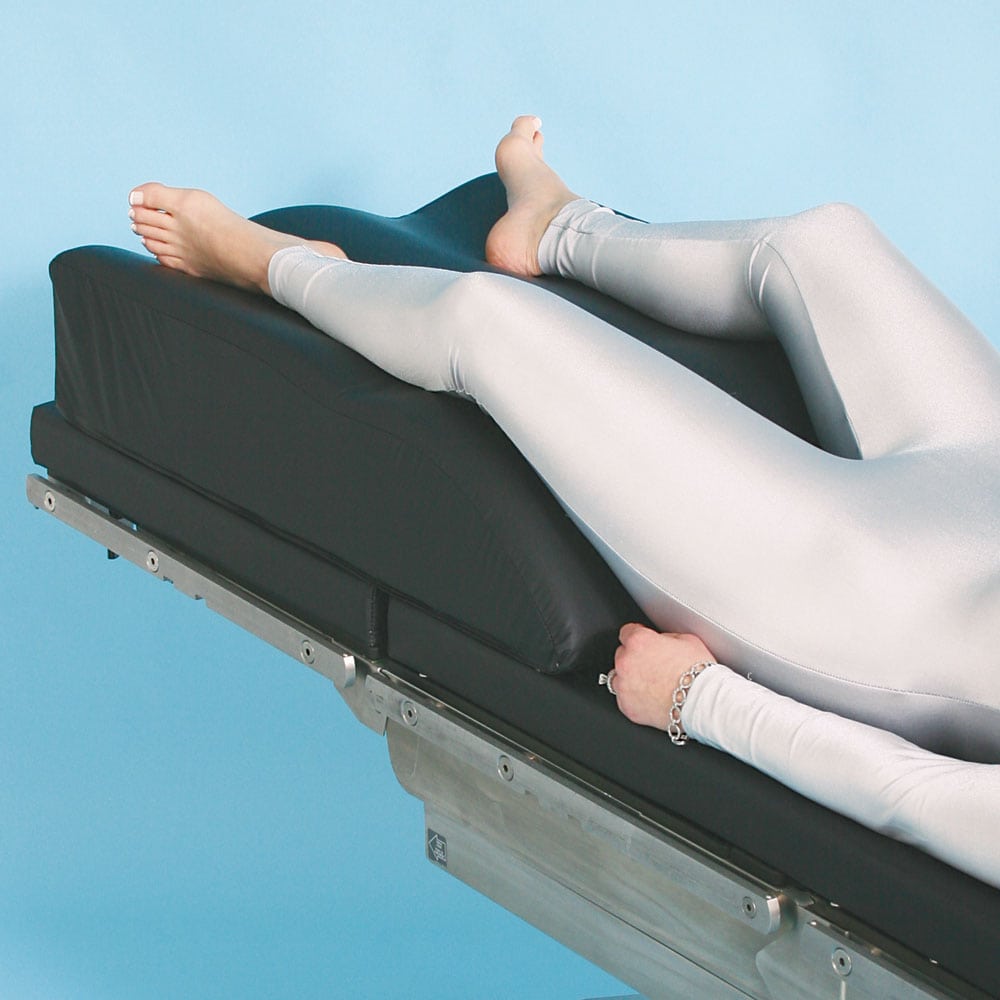
For saphenous vein harvest positioning, the patient is typically supine with the harvest leg supported in slight flexion and external rotation to provide access along the medial leg and thigh. The goal is to create a stable working position that exposes the anticipated vein path without placing unnecessary pressure on the heel, calf, knee, or other vulnerable areas. A purpose-built saphenous vein harvest pad matters because it helps maintain this controlled leg position while supporting the upper thigh, distributing pressure, and giving the harvesting team consistent access throughout the procedure. SchureMed’s Saphenous Vein Harvest Pad is specifically designed to hold the legs externally rotated and slightly flexed for minimally invasive, bridging, or open harvesting procedures during coronary bypass surgery.
Saphenous vein harvesting remains an important component of coronary artery bypass grafting, or CABG. Although harvesting techniques have evolved from traditional open approaches to endoscopic and no-touch methods, each approach depends on reliable access to the lower extremity and careful management of the operative position.
At SchureMed, we design positioning equipment around a straightforward principle: the position should support the patient while creating the access the surgical team needs. Our positioning portfolio includes supports and accessories developed for demanding surgical environments, including dedicated saphenous vein harvesting equipment. Our broader approach to device design also emphasizes surgical access, pressure distribution, OR integration, and solutions tailored to procedural requirements.
Why Positioning Matters During Saphenous Vein Harvest
The great saphenous vein follows the medial aspect of the lower extremity, making leg orientation an important consideration when preparing for harvest. In traditional open harvesting, the vein may be approached through an incision extending along the medial leg or thigh. Endoscopic techniques can use much smaller incisions, but they still require the harvester to establish and maintain an effective working path along the vessel.
The purpose of positioning is therefore not simply to elevate the leg. The setup should create reliable medial exposure while maintaining a controlled, supported posture.
In practical terms, the operative team is balancing several objectives:
- Expose the medial leg and thigh for assessment and harvesting.
- Keep the leg stable enough that the working angle does not change unexpectedly.
- Maintain slight flexion where appropriate for access.
- Provide controlled external rotation without excessive joint stress.
- Reduce concentrated pressure beneath the heel, calf, knee, and thigh.
- Maintain access for prepping, draping, instrumentation, and harvesting equipment.
- Avoid positioning equipment that unnecessarily crowds the surgical field.
SchureMed’s Saphenous Vein Harvest Pad was engineered specifically around these requirements. The pad supports the upper thigh while maintaining the leg in an externally rotated, slightly flexed position intended to facilitate saphenous vein assessment and harvest.
How Is a Patient Positioned for Saphenous Vein Harvest?
For CABG procedures involving saphenous vein harvest, the patient generally begins in the supine position. The leg selected for harvesting is then arranged to give the harvesting team practical access to the medial lower extremity.
With the SchureMed pad, the leg can be maintained in a slightly flexed and externally rotated position. That orientation helps bring the medial aspect of the leg into a more accessible working plane for the surgeon or vein-harvesting specialist. SchureMed specifically identifies this position for minimally invasive, bridging, and open harvesting approaches.
The exact degree of flexion or rotation is not a universal fixed angle. It should be determined by the patient’s anatomy, the harvest technique, the vessel location, the surgeon’s workflow, and the positioning equipment being used. Positioning should always follow the facility’s clinical protocols and the instructions for the devices involved.
A typical setup sequence may include:
- Positioning the patient supine on the surgical table.
- Identifying the leg planned for conduit harvest.
- Placing the harvesting pad so it supports the intended areas of the lower extremity and upper thigh.
- Bringing the leg into controlled external rotation.
- Maintaining slight flexion to improve access along the medial surface.
- Confirming that the leg is supported rather than suspended against isolated pressure points.
- Verifying that the harvesting team has sufficient room for preparation, draping, visualization, instruments, and movement.
- Reassessing the position before the procedure begins.
The final position should provide access without forcing the lower extremity into an exaggerated posture.
The Role of a Saphenous Vein Harvest Pad
A dedicated harvesting pad does more than elevate the leg. Its value comes from maintaining a predictable relationship between the leg, the surgical table, and the operative field.
SchureMed’s Saphenous Vein Harvest Pad measures 32 inches long by 20.5 inches wide by 6.5 inches high, or approximately 81 cm by 52 cm by 17 cm. Its construction combines a conforming upper foam layer with a firmer supportive base. The cover provides multidirectional stretch, while sealed watertight seams and a water-resistant surface support practical cleaning between uses. The cover is also not made with natural rubber latex.
Those design characteristics are important because a harvesting support must perform two different functions at the same time.
First, it needs enough structure to maintain the desired position. A support that compresses excessively may allow the leg to drift, reducing exposure or forcing staff to repeatedly readjust the extremity.
Second, it needs adequate conformity to avoid creating unnecessary localized pressure. SchureMed addresses both objectives through a conforming foam layer supported by a firmer base.
Our broader positioning design philosophy follows the same concept. Properly matched supports should distribute loads, help minimize concentrated pressure, and improve surgical access rather than simply immobilizing the patient.
Leg Positioning and Medial Vein Exposure
External rotation is especially useful because the saphenous vein is approached along the medial aspect of the leg. Rotating the limb outward presents that surface toward the surgical team instead of leaving it directed toward the contralateral leg or table.
Slight flexion can further improve the working relationship between the thigh, knee, and lower leg.
The important word is slight. More positioning is not necessarily better positioning. Extreme external rotation or aggressive flexion can create unnecessary stress and may not improve exposure.
The harvesting team should instead seek a balanced position that provides a clear operative path while keeping the limb supported.
Before final draping, we recommend that the team confirm several practical points:
- Is the medial leg clearly accessible?
- Can the harvesting clinician comfortably reach the anticipated proximal and distal portions of the vein?
- Is the thigh adequately supported?
- Are the heel and other pressure-sensitive areas protected?
- Has the leg remained stable after the final position was established?
- Will the pad interfere with preparation, draping, or equipment movement?
- Can the harvesting team work without repeatedly repositioning the limb?
These checks can help prevent a technically acceptable position from becoming an ergonomically difficult one once the procedure is underway.
Pad Placement Should Support Access, Not Obstruct It
The pad should be positioned before the surgical field is finalized so the team can evaluate both patient support and procedural access.
SchureMed’s design is intended to support the upper thigh and maintain the lower extremity in the externally rotated, slightly flexed posture used for vein assessment and harvesting.
Correct pad placement should create continuous, stable support rather than simply raising one segment of the extremity.
The surgical team should evaluate whether the pad:
- Maintains the required leg orientation.
- Provides appropriate support beneath the thigh.
- Avoids creating concentrated contact areas.
- Leaves the medial leg accessible.
- Remains stable on the OR table.
- Does not interfere with sterile draping.
- Provides enough room around the operative leg for the harvesting clinician.
The pad should also be inspected according to institutional practices before use. Any positioning surface must remain intact and capable of providing its intended support.
Positioning for Open, Bridging, and Endoscopic Harvesting
Different harvesting techniques change the incision strategy and instrumentation, but the need for controlled leg positioning remains.
Open Saphenous Vein Harvest
Traditional open harvesting typically involves an incision along the medial aspect of the leg or thigh. Because the operative path can extend over a substantial distance, consistent medial exposure is particularly important.
The leg should remain positioned so that the surgeon can progress along the harvest path without repeatedly rotating or lifting the extremity.
A stable pad can be especially valuable here because it establishes the working orientation before incision and helps maintain that relationship during the harvest.
Bridging Techniques
Bridging approaches use multiple smaller incisions rather than one continuous long incision.
The harvesting clinician still needs access to multiple points along the same anatomical pathway. Keeping the extremity externally rotated and supported can help maintain consistency as the clinician moves between access points.
SchureMed specifically identifies its Saphenous Vein Harvest Pad for bridging procedures in addition to minimally invasive and open techniques.
Endoscopic Vein Harvesting
Endoscopic vein harvesting uses minimally invasive access and specialized instrumentation to dissect and retrieve the vein. Contemporary EVH techniques are widely used in CABG, and clinical literature has associated them with smaller incisions and reduced leg wound morbidity compared with traditional open harvesting in appropriate settings.
Recent descriptions of EVH workflows also demonstrate the importance of evaluating the lower-extremity venous system and planning the harvest pathway before the procedure.
Because endoscopic instruments must travel along a defined tissue plane, the leg should remain stable enough that the anatomical working pathway does not continually change.
Pressure Relief Is Part of the Positioning Strategy
Surgical exposure is only one component of good positioning. The support system should also account for pressure distribution.
Whenever a lower extremity is elevated, rotated, or held in a specific posture for a prolonged procedure, the clinical team should evaluate where the limb is contacting the support surface.
A positioning device should not solve one access problem by creating another support problem.
SchureMed’s harvesting pad uses a conforming foam top layer over a firm, supportive base. That combination is designed to provide patient support while maintaining the shape necessary for controlled positioning.
Pressure-management considerations may include:
- Avoiding unnecessary compression around the heel.
- Supporting the thigh over a broad surface.
- Preventing the knee or calf from resting against an unnecessarily firm edge.
- Making sure the extremity does not migrate off the support.
- Checking that drapes, tubing, cables, or equipment have not created additional pressure points.
- Reassessing positioning whenever the operative setup changes.
The goal is not simply cushioning. The goal is controlled support with appropriate pressure distribution.
Surgeon Access and OR Ergonomics
Patient positioning should be considered from the surgeon’s perspective as well as the patient’s.
A theoretically ideal anatomical position can still be inefficient if it forces the harvester to lean across the table, work with elevated shoulders, reach around equipment, or repeatedly ask staff to reposition the leg.
Before sterile preparation is completed, the harvesting clinician should have an opportunity to assess the setup from the intended working position.
Consider:
- Which side of the table the harvester will stand on.
- Whether the medial leg is facing the clinician appropriately.
- How easily proximal and distal areas can be reached.
- Where endoscopic or open-harvesting instrumentation will be placed.
- Whether the pad creates adequate clearance rather than restricting it.
- Whether simultaneous cardiac and vein-harvesting workflows can proceed without unnecessary interference.
In CABG procedures, the vein harvest may occur while another portion of the operative workflow is taking place. A predictable, self-supporting leg position can therefore help reduce the need for additional staff to manually manipulate the extremity.
SchureMed develops positioning systems and accessories with this type of OR integration in mind. Our in-house engineering approach considers access angles, equipment clearances, ergonomics, table interfaces, and other procedural constraints when evaluating positioning solutions.
Equipment Should Fit the Complete OR Workflow
The saphenous vein harvest pad is one component of a much larger positioning environment.
The OR team must consider the surgical table, mattress or surface, anesthesia access, sterile field, lines and tubing, patient restraints, other positioning devices, and the equipment required for the primary cardiac procedure.
Compatibility matters because positioning accessories should support the workflow rather than compete for limited table space.
SchureMed offers a broad range of OR positioning accessories, including extremity supports, lateral positioners, guards, restraints, arm supports, and dedicated saphenous vein harvesting equipment. Where rail-mounted devices are required elsewhere in the setup, SchureMed also manufactures OR table clamps engineered to secure positioning accessories to surgical table rails.
When evaluating the full setup, OR teams should look beyond the individual accessory and ask how every component functions together.
Cleaning and Material Considerations
Positioning products used near a surgical field need surfaces that can be incorporated efficiently into the facility’s cleaning workflow.
SchureMed’s Saphenous Vein Harvest Pad uses a water-resistant cover with sealed, watertight seams designed to facilitate cleanup. The multidirectional stretch cover also accommodates the pad’s contoured support configuration, and it is not manufactured with natural rubber latex.
Clinical teams should always follow the manufacturer’s current instructions for use and their facility’s infection-prevention procedures when cleaning or inspecting reusable positioning equipment.
Selecting a Saphenous Vein Harvest Positioning Solution
When evaluating a support for vein harvesting, we recommend looking at more than dimensions alone.
Important considerations include:
- Positioning geometry: Does the support create the external rotation and slight flexion required for the intended workflow?
- Support characteristics: Does it combine conformity with adequate structural support?
- Access: Can the clinician reach the medial leg and thigh without working around the positioning device?
- Stability: Will the leg maintain its orientation throughout the harvesting portion of the procedure?
- Pressure distribution: Does the surface provide broad support instead of concentrated contact?
- Cleanability: Are the surfaces and seams designed for efficient cleaning?
- Technique compatibility: Can the device support the facility’s open, bridging, or minimally invasive harvesting methods?
- OR integration: Will the support fit the table configuration without interfering with other equipment?
The right positioning solution should make the desired posture repeatable rather than forcing the surgical team to reconstruct the setup for every case.
Frequently Asked Questions
How is a patient positioned for saphenous vein harvest?
The patient is generally positioned supine, with the harvest leg supported in slight flexion and external rotation to improve access to the medial leg and thigh. SchureMed’s Saphenous Vein Harvest Pad is designed specifically to maintain this orientation during minimally invasive, bridging, and open harvesting procedures.
Why is external rotation used during saphenous vein harvesting?
External rotation helps present the medial surface of the leg toward the harvesting clinician, improving access to the anatomical pathway of the great saphenous vein. The position should remain controlled and should be adjusted to the patient’s anatomy and the harvesting technique.
What does a saphenous vein harvest pad do?
A saphenous vein harvest pad supports the leg and upper thigh while maintaining a stable externally rotated, slightly flexed position. SchureMed’s pad combines conforming foam with a firm base to provide support while creating the working position needed for vein assessment and harvest.
Can the same positioning pad be used for open and minimally invasive vein harvesting?
SchureMed’s Saphenous Vein Harvest Pad is specifically described for minimally invasive, bridging, and open harvesting procedures used during coronary bypass surgery. The clinical team should always confirm that the chosen setup is appropriate for the surgeon’s technique and the patient’s requirements.
Optimize Saphenous Vein Harvest Positioning With SchureMed
Consistent saphenous vein harvesting begins with a position that supports both the patient and the operative workflow. Slight flexion, controlled external rotation, reliable thigh support, appropriate pressure distribution, and unobstructed medial access can all contribute to a more practical setup for the harvesting team.
At SchureMed, we offer a full line of products designed to optimize patient positioning for demanding surgical requirements. From orthopedic surgery and cardiovascular workflows to pediatric laparoscopic procedures and other specialized applications, we provide positioning devices and OR accessories engineered for precision, reliability, and clinical efficiency.
Our in-house research, engineering, and manufacturing capabilities allow us to evaluate your exact requirements and either recommend an existing solution or develop a positioning device around the needs of your surgical environment. That integrated approach allows us to maintain control over design, manufacturability, quality, and OR compatibility throughout the development process.
For a dedicated solution for coronary bypass preparation, explore our Saphenous Vein Harvest Pad or contact us to discuss your patient positioning and operating room equipment requirements.
