
ISO 13485 is the international quality management system (QMS) standard written specifically for medical device organizations. For buyers, an ISO 13485 medical device certification means an accredited third party has audited the manufacturer’s QMS and found it able to consistently meet customer and regulatory requirements. It certifies the system behind the product, not any single device.
That distinction matters more in 2026 than it did a year ago. The FDA now builds ISO 13485:2016 directly into U.S. device regulation, but a certificate still does not equal FDA compliance. This guide explains what the standard covers, how it relates to the FDA’s new Quality Management System Regulation (QMSR), and how OR managers and procurement teams can verify a positioning equipment vendor’s claims before a purchase order goes out.
What Is the ISO 13485 Medical Device Standard?
ISO 13485:2016, titled Medical devices — Quality management systems — Requirements for regulatory purposes, sets out the QMS requirements specific to the medical device industry. The 2016 revision broadened the standard to cover every organization involved in a device’s life cycle, from concept to end of life, and added a stronger focus on post-market surveillance, including complaint handling (ISO, 2016).
The standard is organized around five core requirement areas:
- Quality management system (Clause 4): documented processes, document control, and record control.
- Management responsibility (Clause 5): leadership accountability, quality policy, and management review.
- Resource management (Clause 6): personnel competence, infrastructure, and work environment.
- Product realization (Clause 7): design and development, purchasing and supplier control, production, and traceability.
- Measurement, analysis, and improvement (Clause 8): complaint handling, internal audits, and corrective and preventive action (CAPA).
For surgical equipment buyers, Clause 7 deserves the closest attention. It governs how a manufacturer turns clinical requirements, such as a stirrup’s weight capacity or a clamp’s rail compatibility, into verified design outputs and controlled production.
What Does ISO 13485 Certification Mean for a Medical Device Manufacturer?
Certification means an independent certification body (often called a registrar) audited the manufacturer’s QMS against ISO 13485 and issued a certificate covering a defined scope and set of sites. ISO itself writes the standard but does not certify companies or accredit certification bodies; national accreditation bodies accredit the certification bodies (ISO, How to verify an accredited certification).
Three things a certificate tells you, and one it doesn’t:
- It does confirm that a documented, audited QMS exists for the activities listed in the certificate’s scope.
- It does confirm that the system is subject to ongoing third-party surveillance audits, not a one-time review.
- It does confirm that design, production, complaint handling, and corrective action are governed by written, auditable procedures.
- It does not confirm that a specific product is safe or effective for your application. That still depends on the product’s own design verification, labeling, and your clinical evaluation.
How Does ISO 13485 Relate to the FDA’s QMSR?
On February 2, 2026, the FDA’s Quality Management System Regulation took effect. It amends the device current good manufacturing practice (CGMP) requirements in 21 CFR Part 820 by incorporating ISO 13485:2016 by reference, along with Clause 3 of ISO 9000:2015 for shared vocabulary (FDA, Quality Management System Regulation).
Several changes are directly relevant to buyers:
- A new inspection process. On the same date, the FDA stopped using the Quality System Inspection Technique (QSIT) and began inspecting under the updated Inspection of Medical Device Manufacturers Compliance Program 7382.850 (FDA, QMSR FAQ).
- Broader record access. FDA investigators can now review management review, internal audit, and supplier audit reports, records that were previously exempt from inspection under the old Quality System regulation.
- Certificates are not a substitute. The FDA states it will not require or issue ISO 13485 certificates, and a certificate does not exempt a manufacturer from an FDA inspection.
| Factor | ISO 13485 certification | FDA QMSR compliance |
|---|---|---|
| Who assesses | Accredited third-party certification body | FDA investigators |
| Basis | Conformance to the ISO 13485:2016 standard | Compliance with 21 CFR Part 820, which incorporates ISO 13485:2016 plus FDA-specific requirements |
| Schedule | Annual audits on a three-year certification cycle | Inspections scheduled based on risk factors |
| Evidence a buyer can request | Current certificate showing scope, sites, and expiration date | The manufacturer’s description of its QMSR alignment and inspection history |
| Limitation | Does not satisfy FDA requirements on its own | FDA does not issue certificates of conformance |
Source for assessor, basis, schedule, and limitation rows: FDA, QMSR Frequently Asked Questions (2026)
Why ISO 13485 Matters When Buying Surgical Positioning Equipment
Positioning equipment carries the patient’s full weight, holds limbs at fixed angles for hours, and attaches to table rails that vary across a facility’s fleet. A QMS built to ISO 13485 gives you a documented trail behind each of those performance claims.
- Design controls behind rated capacities. A stated patient weight capacity or range of motion should trace back to design inputs and verification records, not a marketing sheet.
- Traceability. If a component issue surfaces, a manufacturer with controlled traceability can identify which lots or serial numbers are affected and which facilities received them.
- Complaint handling and CAPA. Field feedback from your OR staff should enter a formal complaint process that can trigger a documented corrective action.
- Supplier control. Purchased components, from pads to fasteners, are evaluated and monitored under Clause 7 purchasing requirements.
For a broader set of vendor-selection criteria beyond quality systems, see our guide to questions surgeons should ask a medical equipment supplier.
How to Verify a Vendor’s ISO 13485 Certification
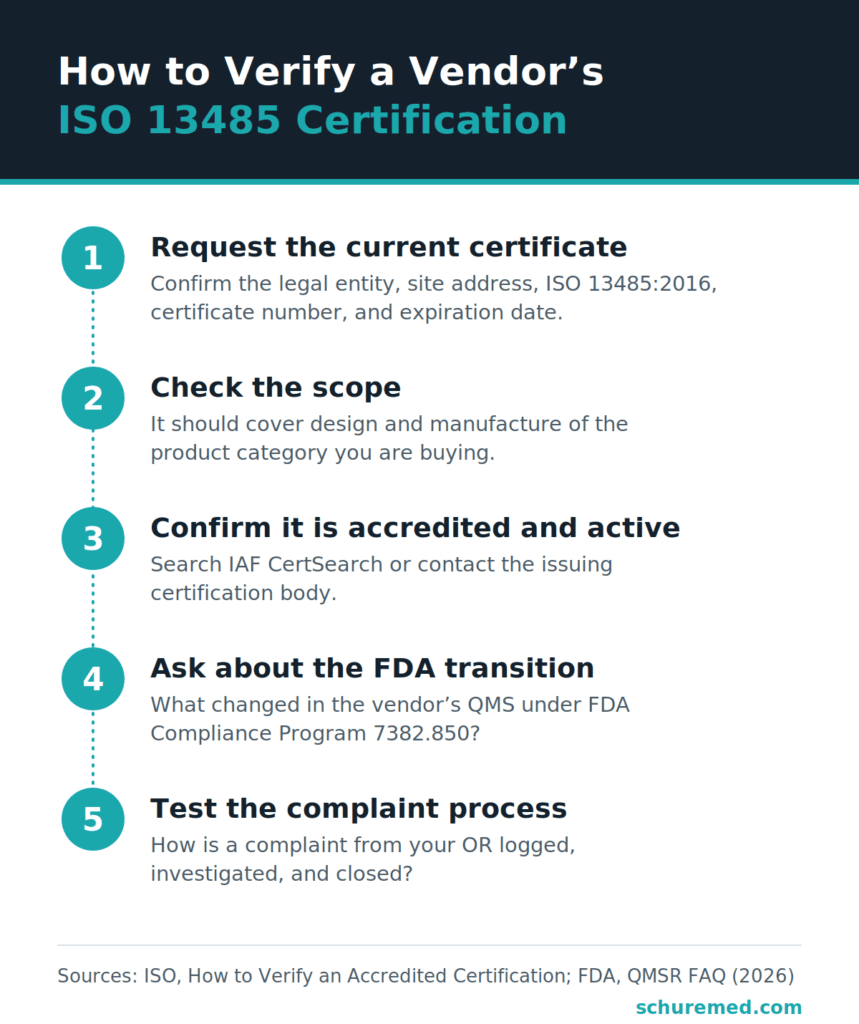
Asking “are you certified?” is the starting point. Verification takes about five steps:
- Request the current certificate. Confirm the legal entity name, the manufacturing site address, the standard version (ISO 13485:2016), the certificate number, and the expiration date.
- Check the scope. Make sure the certified scope covers both design and manufacture of the product category you are buying, not only distribution or servicing.
- Confirm the certificate is accredited and active. Search the International Accreditation Forum’s IAF CertSearch database or contact the issuing certification body. CertSearch lists only accredited certificates (ISO).
- Ask about the FDA transition. A vendor that has aligned its QMS with the QMSR should be able to explain, in operational terms, what changed in its internal audits and records when the FDA moved to Compliance Program 7382.850.
- Test the complaint process. Ask how a complaint from your OR is logged, investigated, and closed, and how long a typical investigation takes.
Vague answers or an inability to produce current documentation are reasons to dig deeper before committing to a purchase.
How SchureMed Approaches Quality Management
SchureMed has been ISO 13485:2016 certified since August 2020. Every product is designed and manufactured in-house at our 37,000 sq. ft. facility in Abington, Massachusetts, which keeps design controls, production, and traceability under one roof rather than spread across offshore suppliers. Our engineers also work directly with surgeons through our bespoke instrument design program when a standard device doesn’t fit the procedure. Learn more about SchureMed’s history and quality commitment.
Frequently Asked Questions
What is the difference between ISO 9001 and ISO 13485?
ISO 9001 is a general quality management standard used across industries. ISO 13485 is written specifically for medical devices and adds requirements tied to regulatory compliance, including documented risk-based processes, design controls, traceability, complaint handling, and post-market surveillance. A medical device manufacturer certified only to ISO 9001 has shown general quality discipline, but not discipline calibrated to device regulations.
Does the FDA require ISO 13485 certification?
No. Since February 2, 2026, the FDA’s QMSR incorporates ISO 13485:2016 by reference into 21 CFR Part 820, so its requirements apply to device manufacturers selling in the U.S. However, the FDA does not require or issue ISO 13485 certificates, and holding one does not exempt a manufacturer from FDA inspection. Certification and FDA compliance are related but separate.
How often are ISO 13485 certified manufacturers audited?
Third-party ISO 13485 audits occur annually under a three-year certification plan, according to the FDA’s QMSR guidance. That ongoing surveillance is part of what gives a current certificate its value. Always check the expiration date on any certificate a vendor provides, and confirm its status with the certification body or IAF CertSearch.
Does ISO 13485 certify individual products?
No. ISO 13485 certifies a manufacturer’s quality management system, not a specific device. It shows the organization can consistently provide devices that meet customer and regulatory requirements. Product-level questions, such as rated weight capacity, compatibility, and reprocessing instructions, should be confirmed through the product’s own specifications and labeling.
Talk to Our Team About Your Positioning Equipment Needs
When you evaluate surgical positioning equipment, a vendor’s quality system is the evidence behind every spec on the page. Browse our full range of surgical patient positioning equipment, request a quote for your facility, or call us at 1-888-724-8763 to discuss your OR’s requirements.
