
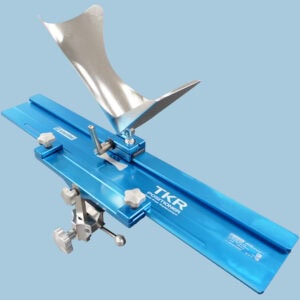
The De Mayo Knee Positioner is a familiar reference point for surgical teams evaluating positioning equipment for total knee replacement, partial knee replacement, and revision procedures. However, it is not the only option available to today’s orthopedic operating rooms. As surgical techniques, sterile processing requirements, imaging workflows, and staff expectations evolve, healthcare facilities should compare modern TKR positioning solutions based on more than brand familiarity. The right system should provide rigid stabilization, controlled intraoperative movement, efficient setup, dependable operating table integration, and a design that supports the complete procedural workflow.
At SchureMed, we develop surgical positioning equipment tailored to the practical needs of surgeons, nurses, sterile processing professionals, and hospital administrators. Our TKR positioning portfolio includes dynamic ball-track positioners, multiple base-plate lengths, the Genos upgraded TKR positioning device, radiolucent SchureFoot knee replacement foot holders, specialized operating room table rail clamps, and complementary accessories. This range enables us to assist surgical teams in identifying a configuration that suits their specific procedures, operating tables, patient population, sterile processing capabilities, and clinical preferences.
Why Surgical Teams Consider De Mayo Knee Positioner Alternatives
The De Mayo Knee Positioner is designed to stabilize and reposition the operative leg during total, partial, and revision knee replacement procedures. Its sliding carriage and locking mechanism provide a useful comparison point for healthcare facilities evaluating available systems.
However, every facility has different clinical and operational priorities. A system that performs adequately in one operating room may not integrate as effectively into another. Table models, rail dimensions, sterile draping practices, room layouts, surgeon preferences, case complexity, autoclave dimensions, and sterile processing procedures can all influence equipment selection.
When we help customers evaluate De Mayo Knee Positioner alternatives, we encourage them to examine questions such as:
- How smoothly can the operative leg move from extension into deeper flexion?
- Can the surgeon introduce tilt and rotation without compromising stability?
- Does the system become completely rigid after it is locked?
- Are there safety stops that prevent the leg holder from leaving the track?
- Can the well leg remain flat on the operating table?
- How quickly can the positioner be attached, adjusted, disassembled, and removed?
- Does the complete system fit into the facility’s available autoclaves?
- Is the sterilization tray organized for efficient processing and reassembly?
- Is the system compatible with the facility’s existing OR table rails?
- Are disposable liners and replacement accessories readily available?
- Can the manufacturer support custom requirements or unusual workflows?
A modern knee positioner should not simply hold the limb. It should function as an integrated mechanical platform that supports surgical exposure, reproducibility, staff efficiency, safe handling, and precise surgeon-directed control.
SchureMed TKR Positioners as Modern Alternatives
Our SchureMed TKR Positioners use ball-track systems developed specifically for knee replacement procedures. A ball joint at the heel of the leg holder allows the operative leg to be positioned in extension, flexion, tilt, and rotation. The assembly moves smoothly along the track and locks in the selected position with a simple wrist motion. Once secured, the positioner is designed to remain rigid.
We offer traditional SchureMed TKR Positioners in two primary lengths:
- 24-inch TKR Positioner, model 800-0141
- 30-inch TKR Positioner, model 800-0171
Both models include a corresponding sterilization tray and one disposable TKR boot liner. Their reusable components are autoclavable, supporting repeat use within properly managed sterile processing workflows.
We also offer the Genos TKR Positioner, model 800-0409, which is our new, upgraded 30-inch TKR positioning system. The Genos retains the smooth movement, heel-centered ball-track control, rigid locking, tilt, rotation, flexion, and extension capabilities expected from a modern positioning device while incorporating several important design improvements.
The Genos includes a pull-apart track system constructed from two 15-inch base-plate sections. When connected, the sections create a full 30-inch positioning track. When separated, the complete system and its components fit into a compact sterilization tray measuring approximately 17 inches by 13 inches. This smaller tray footprint makes the Genos compatible with a wider range of autoclave sizes while also simplifying storage and transport.
Additional Genos features include:
- Two connectable 15-inch base plates forming a 30-inch track
- A compact sterilization tray for broader autoclave compatibility
- Designated slots and holders for organized component placement
- More intuitive assembly and disassembly
- Built-in stops at both ends of the track
- Protection against the leg holder accidentally sliding off the base plate
- Smooth movement through extension and varying degrees of flexion
- Heel-centered tilt and rotation
- Rigid wrist-operated locking
- Autoclavable reusable components
- Compatibility with SchureMed TKR boot liners
These improvements make the Genos particularly valuable for facilities that want advanced leg control without requiring an oversized sterilization tray.
Comparing Intraoperative Range of Motion
A key requirement for any De Mayo Knee Positioner alternative is controlled range of motion. Total knee replacement involves multiple procedural stages, and the operative leg may need to transition repeatedly between extension and flexion. Surgeons may also need to tilt or rotate the extremity to improve access, evaluate ligament balance, assess stability, or accommodate a specific surgical approach.
Our SchureMed ball-track systems support:
- Full extension
- Variable degrees of flexion
- Medial and lateral tilt
- Controlled leg rotation
- Smooth repositioning along the base plate
- Rigid fixation after the selected position is locked
This combination is important because mobility and stability must function together. A device that is highly adjustable but difficult to secure can interrupt the procedure. Conversely, a rigid support that requires cumbersome manual repositioning may create unnecessary strain, increase staff handling, and slow the surgical workflow.
The objective is controlled movement when an adjustment is required and dependable rigidity once the operative position has been established. Our TKR systems are engineered to provide both.
Evaluating Locking Mechanisms and Mechanical Stability
The locking mechanism is one of the most important areas to compare among modern knee positioners. It directly affects how the system feels in the surgeon’s hands and how confidently the extremity can be maintained throughout the procedure.
Our TKR Positioners lock through a wrist-operated control on the adjustable slide block. The track-locking bracket secures the base plate to the operating table, while the heel-mounted ball-track assembly controls flexion, extension, tilt, and rotation.
The Genos further improves track safety by incorporating built-in stops at each end of the connected base plates. These stops help prevent the leg holder from accidentally sliding off the positioning track during setup, adjustment, disassembly, or intraoperative use.
When comparing locking and track designs, surgical teams should evaluate:
- Whether the control can be reached from the preferred working position
- Whether adjustments can be performed without excessive force
- Whether the carriage moves smoothly before locking
- Whether the system exhibits unwanted play after locking
- Whether the base remains stable during manipulation
- Whether the leg holder is protected from leaving the track
- Whether staff can operate the mechanism consistently while wearing surgical gloves
- Whether the locking action provides clear tactile confirmation
A high-quality locking system should create a distinct transition between free movement and fixed positioning. The operator should not have to question whether the device is fully engaged.
The Importance of Operating Table Integration
A positioner is only as effective as its connection to the operating table. Inconsistent rail compatibility or an unstable clamp can undermine an otherwise capable system.
Our TKR Positioners require a compatible CamLoc Rail Clamp, which is SchureMed’s operating room table rail clamp for mounting surgical accessories. Standard CamLoc models accept round accessory posts up to 5/8 inch in diameter, or 1.6 centimeters, and flat mounting posts up to 1 inch by 3/8 inch, or 2.5 centimeters by .95 centimeters. We also offer a low-profile CamLoc model that accepts rectangular mounting posts and remains compatible with our TKR Positioners.
The CamLoc Rail Clamp is designed for use within the sterile field and can be attached over surgical drapes. Standard and large configurations are available to accommodate different draping thicknesses. SchureMed also provides CamLoc options for different international rail dimensions and table standards.
This level of clamp selection is important for hospitals with mixed table inventories or equipment manufactured for different regional standards. Before purchasing any TKR positioning system, facilities should confirm:
- Side-rail width and height
- Rail shape and applicable standard
- Whether the clamp can attach over rail stand-offs
- The number and thickness of drapes used
- Whether the accessory post is round or rectangular
- Whether a standard or low-profile clamp is preferred
- Whether the clamp can be positioned at the required point along the rail
A secure interface among the operating table, clamp, track, and positioner creates the mechanical foundation for the entire setup.
Sterile Processing and Turnover Considerations
Clinical performance is only one component of equipment selection. A modern TKR positioner must also fit the hospital’s cleaning, sterilization, storage, assembly, and case-turnover processes.
Our 24-inch and traditional 30-inch TKR Positioners include custom sterilization trays, and their reusable components are autoclavable. Disposable boot liners are available separately to support efficient patient-contact management between procedures.
For facilities with smaller autoclaves, limited sterile processing space, or compact storage areas, the Genos provides a significant advantage. Its pull-apart design divides the 30-inch track into two 15-inch base-plate sections. The sections, leg holder, locking components, and related accessories fit into a compact sterilization tray measuring approximately 17 inches by 13 inches.
This design provides several practical benefits:
- Compatibility with a broader range of autoclave chamber sizes
- Reduced sterilization-tray footprint
- Easier storage in compact sterile processing areas
- More manageable transport between departments
- Intuitive slots and holders for every major component
- Improved component organization
- Faster visual confirmation that all parts are present
- More efficient assembly and disassembly
- Protection for components during storage and sterilization
The organized tray is not simply a storage container. It supports a more controlled processing workflow by giving each component a designated location. Staff can identify missing parts more easily, organize the system consistently, and prepare the positioner for subsequent cases with fewer uncertainties.
By combining a full 30-inch clinical track with compact 15-inch sections for sterilization, the Genos provides the working length required in the operating room without creating the processing limitations associated with a one-piece 30-inch base.
Keeping the Well Leg Flat
One advantage of our TKR Positioners is that the patient’s well leg can remain flat on the operating table. This may eliminate the need for a separate well-leg positioning device in appropriate cases.
Reducing the number of auxiliary supports can simplify setup, decrease equipment congestion around the table, and help staff maintain a more standardized room configuration. It can also reduce the number of separate devices that must be located, attached, cleaned, processed, and stored.
Patient positioning decisions must always be made by trained medical professionals based on the procedure, patient anatomy, clinical condition, and applicable facility protocols. Our equipment is designed to support clinical judgment by providing reliable, controllable positioning options.
SchureFoot as a Different Type of TKR Positioning Solution
Not every surgical team requires a sliding ball-track positioner. Some may prefer a fixed foot-support approach for selected knee replacement workflows.
Our SchureFoot is a radiolucent knee replacement foot holder that secures the patient’s foot while allowing the well leg to remain flat. It mounts to the operating table side rail using a Schure Socket XL, which is a heavy-duty OR table rail clamp designed to accept round mounting posts up to 5/8 inch in diameter and rectangular posts up to 1 inch by 3/8 inch. The Schure Socket XL can attach at multiple locations along a standard operating table rail, including over rail stand-offs, and is engineered to provide strong accessory fixation.
We offer two primary SchureFoot constructions:
- Clear Lexan SchureFoot
- Carbon-fiber SchureFoot
Both versions are radiolucent and include a disposable conductive foot pad. The carbon-fiber model provides a lightweight material option while maintaining imaging access.
The SchureFoot is not a direct mechanical equivalent to a carriage-based knee positioner. Instead, it represents a different positioning strategy. It may be considered when the clinical team prioritizes fixed foot stabilization, radiolucency, a reduced mechanical footprint, or a specific surgeon-directed workflow.
Ball-Track Positioner Versus Fixed Foot Support
When comparing modern TKR solutions, the decision often comes down to the type of operative control required.
A ball-track positioner may be preferred when:
- The leg must be moved repeatedly through multiple positions
- Flexion, extension, tilt, and rotation are required
- The surgeon wants controlled movement along a track
- Reproducible intraoperative repositioning is a priority
- The team wants rigid locking at multiple points
- A complete leg holder is preferred
A fixed foot holder may be preferred when:
- The surgeon uses a simpler positioning sequence
- Radiolucency is a major consideration
- A smaller mechanical footprint is beneficial
- The team prefers a side-rail-mounted support
- The procedure does not require continuous track-based movement
Because SchureMed offers both approaches, we can help facilities evaluate the solution that best supports their surgical techniques and equipment environment.
Comparing Total Cost Beyond the Initial Purchase
Purchase price is an important part of any capital-equipment evaluation, particularly when procurement teams must maximize a fixed operating room budget. SchureMed’s pricing generally falls below that of competing positioning systems, which can allow healthcare facilities to purchase more devices, equip additional operating rooms, or standardize positioning equipment across a broader surgical program without increasing the available budget.
Our products are also manufactured in the United States. By maintaining in-house research, engineering, manufacturing, inspection, and quality-control capabilities, we retain greater control over product consistency, availability, technical support, and production costs.
A complete total-cost analysis should consider:
- Initial acquisition price
- Number of devices that can be purchased within the approved budget
- Required clamps and mounting accessories
- Sterilization trays
- Disposable boot liners or pads
- Replacement components
- Staff training requirements
- Setup and removal time
- Storage requirements
- Autoclave compatibility
- Equipment durability
- Manufacturer responsiveness
- Availability of technical support
- Potential need for custom modifications
At SchureMed, our in-house research, design, and manufacturing capabilities allow us to evaluate both standard and specialized requirements. We can recommend an existing solution or work with a facility to develop a positioning device around a specific clinical challenge.
Our bespoke development process considers access angles, imaging constraints, patient sizes, operating table interfaces, sterilization requirements, load conditions, ergonomics, and manufacturability. Because we maintain design and production capabilities within one organization, clinical feedback can be carried through conceptual design, prototyping, engineering, testing, and manufacturing.
What to Look for During a Product Evaluation
A product demonstration should simulate the actual clinical workflow as closely as possible. We recommend evaluating the system with representatives from surgery, nursing, sterile processing, biomedical engineering, and procurement.
During the evaluation, teams should verify:
- Attachment to the facility’s actual OR table
- Clamp security over the typical drape configuration
- Smooth movement through the expected range
- Stability after locking
- Protection against the leg holder leaving the track
- Surgeon access to controls
- Compatibility with preferred working positions
- Ease of boot or foot placement
- Accommodations for different patient sizes
- Cleaning and sterilization procedures
- Tray fit within the facility’s autoclave
- Organization of components within the sterilization tray
- Assembly and disassembly requirements
- Storage needs between cases
- Availability of accessories and replacement components
A technically advanced positioner should also be practical. The most sophisticated mechanism provides limited value if the system is difficult to process, store, attach, or operate consistently.
Frequently Asked Questions
What is a De Mayo Knee Positioner alternative?
A De Mayo Knee Positioner alternative is another surgical positioning system designed to stabilize and reposition the operative leg during total, partial, or revision knee replacement procedures. Alternatives may use sliding tracks, ball joints, fixed foot supports, or other controlled positioning mechanisms.
What is the main advantage of a SchureMed TKR Positioner?
Our TKR Positioners combine smooth track-based movement with heel-centered ball-joint control, allowing the operative leg to move through extension, flexion, tilt, and rotation before being locked rigidly in the selected position.
What is different about the Genos TKR Positioner?
The Genos is our upgraded 30-inch TKR Positioner. It features two connectable 15-inch base plates, a compact sterilization tray measuring approximately 17 inches by 13 inches, organized component holders, and built-in track stops that help prevent the leg holder from sliding off the base plate.
Why does the Genos use two base-plate sections?
The pull-apart system allows the full 30-inch track to fit into a much smaller sterilization tray. This makes the Genos compatible with a broader range of autoclave sizes and simplifies storage, transport, assembly, and disassembly.
Is the SchureMed TKR Positioner available in different sizes?
Yes. We offer traditional 24-inch and 30-inch TKR Positioners, as well as the upgraded 30-inch Genos TKR Positioner.
Does the positioner include a sterilization tray?
Yes. Our TKR Positioners include corresponding sterilization trays. The Genos includes a compact tray with designated locations for its components.
Are the reusable components autoclavable?
Yes. The reusable components are autoclavable. Facilities should always follow the current Instructions for Use and their established sterile processing protocols.
Is an OR table rail clamp required?
Yes. Our track-based TKR Positioners require a compatible CamLoc Rail Clamp. Standard and low-profile configurations are available for applicable mounting posts, table rails, and clinical setups.
Can the well leg remain flat?
Yes. Our TKR Positioners and SchureFoot knee replacement foot holders allow the well leg to remain flat in appropriate procedures.
Does SchureMed offer a radiolucent option?
Yes. Our SchureFoot is available in clear Lexan and carbon-fiber versions. Both are designed to provide radiolucent foot stabilization during knee replacement procedures.
Are SchureMed products manufactured in the United States?
Yes. SchureMed manufactures its surgical positioning products in the United States using our in-house engineering, manufacturing, inspection, and quality-control capabilities.
Can SchureMed develop a custom positioning solution?
Yes. Our in-house design engineers and manufacturing teams can evaluate specialized clinical, mechanical, imaging, table-integration, and workflow requirements. We can recommend an existing product or design and build a custom solution from the ground up.
Compare Modern TKR Positioning Solutions With SchureMed
Choosing among De Mayo Knee Positioner alternatives requires a detailed assessment of range of motion, rigidity, track safety, operating table compatibility, sterile processing, tray size, component organization, accessories, room configuration, surgeon preference, and total cost.
At SchureMed, we offer a full line of products designed to optimize patient positioning across orthopedic surgery, pediatric laparoscopic procedures, and other demanding surgical specialties. Our traditional TKR Positioners, upgraded Genos TKR Positioner, radiolucent SchureFoot options, heavy-duty table clamps, and complementary accessories give surgical teams multiple ways to build an efficient and reliable knee replacement positioning workflow.
Our in-house research, engineering, and U.S. manufacturing teams allow us to produce high-quality operating room equipment at pricing that generally falls below competing solutions. This can help procurement teams equip more operating rooms, purchase additional devices, or standardize equipment across facilities while remaining within a fixed budget.
Our state-of-the-art manufacturing facility, experienced design engineers, and knowledgeable inside staff can assess your exact requirements, recommend the appropriate product, or design and manufacture a specialized solution around your operating room.
Visit our website to learn more about our TKR positioning systems and complete surgical positioning portfolio. To request product information, discuss your operating room requirements, or receive a quote, email our team directly at [email protected].
